Best Thunderbolt Audio Interfaces for Mac: Quick Guide to Top Picks
When searching for the best thunderbolt audio interface for Mac, you want high fidelity, low latency, and reliable drivers. This guide highlights five top options that align with Mac workflows, including Thunderbolt 4/USB4 compatibility where available and strong DSP or preamp performance. Ideal buyers: professional music producers and engineers need large-scale I/O and robust monitoring; podcasters and streamers benefit from easy setup and solid software bundles. The table below compares core specs to help you pick quickly.
| Product | Best For | Key Strength | Notes |
|---|---|---|---|
| MOTU 16A | Professionals needing extensive I/O | 32×34 channels, Thunderbolt 4/USB4 | High-end metering and networked routing |
| Universal Audio UAD 2 Satellite OCTO Core | Pro studios with UAD plugins | Massive DSP, 100+ plugins | Thunderbolt 3, PCIe ecosystem |
| Focusrite Scarlett Solo 4th Gen | Solo artists and beginners | Air mode for vocal/guitar, 120dB dynamic range | USB-C; best value for simple setups |
| Focusrite Scarlett 2i2 4th Gen | Songwriters and podcasters | Auto Gain, Clip Safe | USB-C; flexible inputs for two mics/insts |
| M-AUDIO M-Track Duo | Streamers and mobile producers | Dual XLR/Line/DI inputs | USB; compact and portable |
MOTU 16A 32×34 Thunderbolt 4/USB4 Interface

The MOTU 16A is built for Mac users who require extensive connection options and robust performance. It leverages Thunderbolt 4 / USB4 to deliver up to 192 kHz sampling with advanced metering via a 3.9-inch TFT display. This model is best for professionals who manage large projects or collaborating studios that require reliable routing and high dynamic range. A potential limitation is the higher price point, which may not suit casual home studios.
Universal Audio UAD 2 Satellite OCTO Core

The UAD Satellite OCTO Core is designed for Mac and PC users who run processor-intensive plug-ins. With multiple SHARK DSP processors, it speeds up large mixes and offers access to a broad plugin library, making it ideal for studios that rely on classic analog emulations. Best for: users who need extensive plugin power and offline mix capability. Limitation: DSP availability can be a consideration for those with lighter plugin needs.
Focusrite Scarlett Solo 4th Gen USB Audio Interface

Best for solo performers and vocalists, the Scarlett Solo 4th Gen brings studio-grade sound with a 120dB dynamic range and Air mode to brighten vocals and guitar. It uses high-quality mic preamps and reliable drivers for Mac, offering simplicity and strong fidelity in a compact footprint. Choose this if you want straightforward USB-C connectivity and a single-channel front-end setup. Caution: fewer inputs than larger Focusrite models if you plan to record multiple sources simultaneously.
Focusrite Scarlett 2i2 4th Gen USB Audio Interface
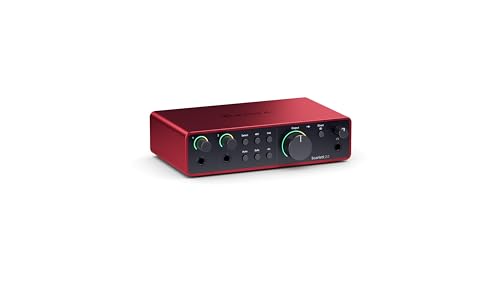
Designed for writers, podcasters, and musicians, the Scarlett 2i2 4th Gen offers two mic/line inputs, Auto Gain, and Clip Safe. It’s well-suited for Mac-based home studios that need dependable two-input recording with a straightforward software bundle. Better for: individuals needing more flexibility than a Solo model but without expanding to a larger interface. Limitation: USB-C only, which may require adapters on some older Macs.
M-AUDIO M-Track Duo USB Audio Interface

The M-AUDIO M-Track Duo is a compact option for Mac users who need two inputs and simple monitoring. It provides 48kHz recording and dual XLR/Line/DI inputs with a straightforward USB connection. Choose this for mobile setups, demos, or small podcasting rigs where space and budget are primary concerns. Limitation: USB-based and 48kHz ceiling may be limiting for higher-resolution projects.
Buying Guide: Thunderbolt Interfaces for Mac
- Compatibility: Verify whether the device supports Thunderbolt 3/4 or USB-C and ensure your Mac supports the interface’s required protocol.
- Latency and DSP: Thunderbolt interfaces often deliver lower latency for real-time monitoring. DSP power (for UAD, for example) helps run plugins without taxing your CPU.
- Input/Output: Count channels, mic/line inputs, instrument inputs, and monitor options. Plan for future expansion if you work with bands or multiple musicians.
- Software Bundle: Consider the included software and drivers. Some brands offer powerful suites that add immediate value.
- Build and Form Factor: For mobile setups, a compact unit with bus power can simplify travel; for studio rigs, rack-mounted or desktop models provide easier management.
- Future-Proofing: While TB is common, USB-C interfaces offer broad compatibility. If you anticipate switching Macs, check driver support and cross-platform reliability.
Frequently Asked Questions
- What is the main advantage of Thunderbolt over USB for audio interfaces?
Thunderbolt typically provides lower latency and higher throughput, enabling more channels and stable multi-track playback with demanding software. - Can I use USB interfaces on a Mac with Thunderbolt-only ports?
Yes, most USB interfaces are compatible via USB-C/USB-A adapters or hubs, but ensure driver support and latency expectations. - Do I need DSP in an audio interface?
DSP helps offload plugin processing from your computer, useful for heavy plugin chains or live monitoring scenarios. - Is it better to buy a high-channel-count interface now or upgrade later?
If your workflow demands many inputs or complex routing now, invest in higher I/O; otherwise, start with a smaller model and grow. - Are Mac users restricted to certain brands?
Most major brands support macOS, but verify driver availability and ongoing software updates for your macOS version. - What should I consider for podcasting vs. music production?
For podcasting, prioritize clean preamps, monitoring, and USB ease. For music production, prioritize low latency, high headroom, and plugin compatibility.