
Best TRS to Mini Jack Cables for Clear Audio
Facing compatibility gaps between 3.5mm (mini jack) and 6.35mm (1/4 inch) ports? This guide highlights five reliable TRS to mini jack cables that ensure strong, interference-free audio transmission. Ideal for musicians, home theater enthusiasts, and mobile users who need a dependable connection between phones, laptops, mixers, amps, and legacy equipment. Each option is chosen for broad device compatibility, durability, and easy plug-and-play use. The table below provides quick reference before diving into detailed product insights.
| Product | Brand | Length | Best For |
|---|---|---|---|
| 6.35mm to 3.5mm Audio Cable Braided | AILKIN | 6.6 ft | Casual and semi-professional setups with 3.5mm to 1/4″ needs |
| J&D 3.5mm to 6.35mm Stereo Cable | J&D | 3.3 ft | Guitars, keyboards, home theater, and studio devices |
| JSAUX 3.5mm to 6.35mm Stereo Cable | JSAUX | 4 ft | Reliable, durable everyday use |
| MOSWAG 3.5mm TRS to Dual 6.35mm | MOSWAG | 3.28 ft | Pro audio setups, mixers, and AV systems |
| XANHAM 3.5mm TRS Stereo Aux Cable | XANHAM | 3.3 ft | Phones, tablets, car audio, and portable players |
Note: Each product supports plug-and-play operation and general audio transmission requirements. Consider length, durability, and whether you need dual mono or stereo signal paths when choosing.
6.35mm To 3.5mm Audio Cable Braided By AILKIN

Features: Wide compatibility with devices and professional equipment, bidirectional 1/8″ to 1/4″ TRS, 6.6 ft length, plug-and-play design. The cable supports connection from 3.5mm devices to 6.35mm inputs and vice versa. This is best for users who need flexible room-to-device reach and straightforward setup. Best for hobbyists and semi-professional rigs. Caution: The length may be more than needed for very compact desks.
J&D 3.5mm To 6.35mm Stereo Cable

Features: 24K gold-plated connectors, double shielding, pure copper core for high-fidelity signal, durable copper shell and flexible jacket. Suitable for connecting smartphones or players to guitar amps, pianos, or home theater devices. Best for users prioritizing low signal loss and robust longevity. Caution: Mono configuration means it may not pass stereo signals in some setups; verify your device’s port configuration.
Tisino 1/8″ To 1/4″ Stereo Cable

Features: 3.3 ft length, dual 1/4″ mono outputs, 20 AWG 4N Oxygen Free Copper, shielding for high-fidelity sound, designed for smartphones or laptops to 6.35 mm inputs. Best for splitting or combining stereo signals across two mono paths. Caution: Distance to the split point is about 19.8 inches; plan routing accordingly.
JSAUX 3.5mm To 6.35mm Stereo Cable

Features: 24K gold-plated connectors, pure silver wire core, double-braided nylon for durability, 15,000+ bend lifespan. Best for long-term use with high durability and resistance to tangling. Caution: Some users may prefer longer lengths for stage setups where distance is a factor.
MOSWAG 3.5mm TRS To Dual 6.35mm
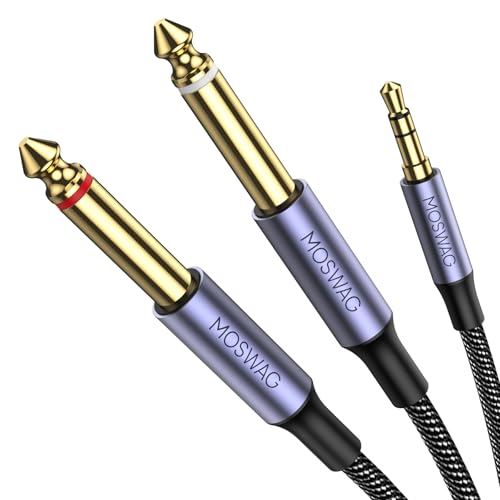
Features: 2 x 6.35mm mono outputs, nylon braided construction for tangle resistance, 25 cm length, designed for connecting mini jacks to professional gear like mixers or AV receivers. Best for compact studio or stage use. Caution: Shorter length may require closer placement of devices; consider if you need more reach.
XANHAM 3.5mm TRS Stereo Aux Cable

Features: 24K gold-plated solid copper connectors, OFC copper core, shielded by braiding for stable signal transmission. Best for general use with mobile devices and car audio. Caution: Not all longer runs come with identical shielding; verify shielding on longer cables for critical audio chains.
Buying Guide
What should you consider when choosing a TRS to mini jack cable?
- Connector type and direction: Some cables are bidirectional, connecting 3.5mm to 1/4″ in either direction. Ensure the cable matches your device’s port type and desired direction of signal flow.
- Length needs: Longer cables provide flexibility but can introduce minor signal loss or more bulk. Choose length that fits your setup without excess slack.
- Durability and build: Look for braided jackets, gold-plated connectors, and robust strain relief when you expect frequent plugging and unplugging.
- Signal quality: Cables with OFC copper cores and shielding reduce EMI/RFI interference and maintain fidelity, especially in pro audio environments.
- Compatibility: Consider whether you’ll connect to consumer devices (phones, laptops) or pro gear (mixers, amplifiers, studio headphones). Some cables support dual mono paths, others stereo.
Pro and Beginner Perspectives
- Pro users: Prioritize shielded cables with durable connectors and confidence in long-term stability. Dual-mono paths or dual outputs can simplify complex rigs.
- Casual users: A reliable, flexible cable with good shielding and easy plug-and-play setup is often sufficient for home theater or personal listening.
Comparison Snapshot
- Best overall balance: AILKIN or JSAUX for durable build and broad compatibility.
- Best for studio/pro setups: MOSWAG for its dual 6.35mm outputs and sturdy construction.
- Best value for mobile use: XANHAM or J&D for solid signal and portability.
Frequently Asked Questions
- What does TRS mean in these cables? It stands for Tip-Ring-Sleeve, a type of stereo plug used for balanced or unbalanced signals.
- Do these cables support stereo signals both ways? Some are bidirectional; check product details to confirm if you need 3.5mm to 1/4″ in both directions.
- Will any 3.5mm to 1/4″ cable work with my guitar amp? If the amp accepts a standard 1/4″ TRS or TS input, these cables should work; verify whether your device requires mono or stereo.
- Which length should I choose for on-stage use? Longer cables reduce crowding but can introduce more signal path length; balance space and distance requirements.
- Are these cables compatible with smartphones? Many are suitable for smartphones with standard 3.5mm outputs, but recent models may omit the headphone jack; use adapters as needed.
- Do cables affect audio quality significantly? High-quality cores, shielding, and connectors reduce loss and noise, improving clarity in sensitive audio setups.